Radio Contact with Grand Junction
The Dog StarsRadio Contact with Grand Junction is a brief, ambiguous exchange that gives Hig evidence of a possible survivor beyond his isolated airport without giving him certainty or a safe way to follow the signal. Heard during what he describes as his seventh year alone, the transmission interrupts a routine call with the possibility that another pilot, perhaps at Grand Junction, is still alive. Its importance lies as much in what remains unknown as in what the radio seems to confirm.
Background and the Call
When Hig receives no response from the airport he is about to fly over, he switches back to the emergency frequency and makes what he calls a pro forma call. His Mayday identifies Cessna Six Triple Three Alpha and admits to feeling lonely. The call is not presented as a carefully planned search operation; it is a familiar procedure made against the silence that has become ordinary. That casualness makes the answer a rupture: after years of hearing nothing, someone responds.
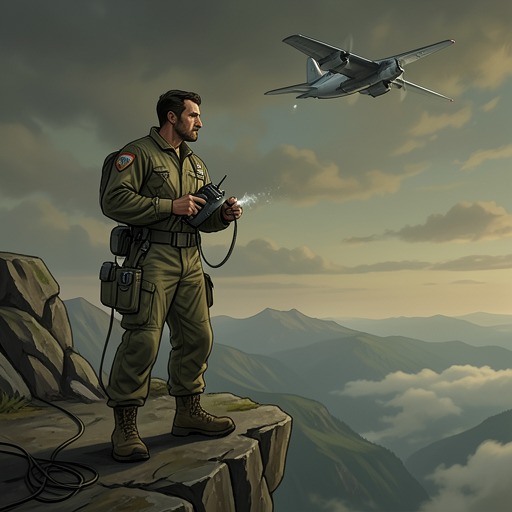
The voice arrives through static and fades with a Doppler shift. Hig catches the words Triple Three Alpha, then a fragment sounding like Grand Junction, before the signal breaks up again. He keys the microphone and calls back, identifying himself as Triple Three Alpha over Longmont. He is startled by where he is and urgently asks the other speaker to repeat, saying that he did not copy the transmission. The exchange offers a place-name but not a clear message, and Hig cannot establish the caller’s identity or circumstances.
A Search Inside the Signal
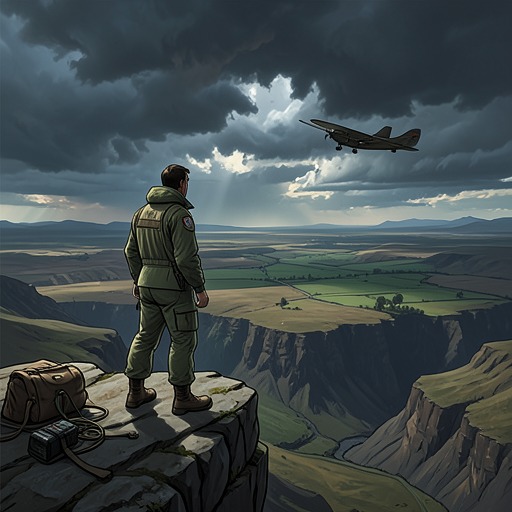
Hig does not immediately turn away. He circles, climbs to fifteen thousand feet, and circles until hypoxia makes him dizzy. He descends to thirteen thousand feet and continues circling for two hours, trying to recover the voice. The fuel-flow gauge eventually shows that he has only fifteen minutes left, forcing him to bank east and abandon the attempt. The episode thus turns on a sharp limit: the possibility of contact pulls him to remain aloft, but the aircraft’s dwindling fuel makes continued listening a threat to his return.
Hig later judges that the speaker was a pilot or a controller, but this remains an inference rather than a confirmed identification. In a subsequent recollection, the voice seems older, competent, kind, and concerned; Hig compares its tone to a grandparent calling up a steep flight of stairs. He remembers the voice as belonging to another pilot. These impressions make the signal intimate without resolving its factual uncertainty: a human presence can be heard, but the person cannot be located, questioned, or verified.
The Memory Returns
The contact resurfaces at night while Hig lies beside Jasper, who is sleeping against him near the berm. The scene is set in early spring, with Orion above the mountains, and Hig’s thoughts had been circling familiar possibilities: the green house, the hangar, and a spring bear hunt. Jasper’s quiet breathing precedes the memory, which comes back to Hig despite his effort to keep his thoughts tightly leashed. The radio call returns in the same pattern as it first reached him: it swells out of static, briefly becomes legible, and recedes into noise.
Hig’s account of when it happened is approximate. He first places the answer in year seven; remembering it later, he wonders whether it was two or three years ago and recalls that it was summer. He also remembers smoke from summer fires, circling The Beast upward through the smoke, and a sunset that seemed like a massacre. The remembered flight gives the brief transmission a physical setting, but it does not supply the missing details of the conversation. Time has not clarified what the caller said; instead, Hig has carried the incomplete sound forward as an unresolved encounter.
Consequences and Significance
The signal changes what Hig can imagine, not what he can prove. He works out that he might fly to Gunnison and back on his tanks, or possibly reach Delta, Colorado by another route if the wind cooperates in both directions. That favorable wind is rare, and Grand Junction lies less than half an hour beyond. Hig has considered making the trip again and again. The route is technically imaginable, but it would take him toward another airport that might be much less secure than his own. He cannot know what awaits there, even if the voice once belonged to someone who had survived seven years.
The call therefore establishes neither a reunion nor a rescue. It leaves Hig with a fragile conjunction of hope and danger: someone may have answered, may have had power, and may still be alive, yet the evidence is one fading transmission and the cost of investigating is real. As the memory continues to trouble him, the contact becomes more than a failed radio exchange. It is a narrow opening in the silence, wide enough to make Grand Junction a destination he repeatedly considers, but not wide enough to tell him whether anyone is still there.